
-
Official Websites of
-
MINISTRY OF
PLANTATION AND COMMODITIES -
No. 15, Level 5-13, Persiaran Perdana, Presint 2, 62654 Wilayah Persekutuan Putrajaya


ARKIB BERITA
- Details
- Hits: 551

KUALA LUMPUR: OCBC Global Markets Research has revised its 2024 crude palm oil (CPO) prices to average RM3,650 per tonne up from the previous estimate of RM3,400.
In the Monthly Commodity Outlook, the research firm said the upward price revision reflects a growing supply risk as El Nino weather disruption continues into 2024 with a mild but increasing intensity.
Both the Malaysian Palm Oil Board (MPOB) and the Indonesia Palm Oil Association (GAPKI) expect production to be largely stagnant this year due to the El Nino disruption.
Additionally, Indonesia's efforts to boost its biofuels usage could potentially reduce its palm oil exports.
GAPKI expects Indonesia's palm oil exports to fall by roughly four per cent to 29 tonnes this year compared to 2023 levels as domestic demand for the B35 blend mandate (35 per cent palm-based biodieselblended with 65 per cent diesel) rises.
A smaller price spread between palm oil and other vegetable oils may further encourage biofuel blending, it said.
Admittedly, OCBC Research said the intensity and duration of El Nino will remain a wildcard in the coming months.
"That being said, we expect the CPO price to trade within a range in the near term, on account of narrowing discounts of palm oil over other vegetable oils," it said.
Moreover, the US Department of Agriculture (USDA) projected in its December WASDE report that soybean oil supply will increase by 2.9 million tonnes in 2023/2024 to reach 61.9 million tonnes.
This, in turn, contributes to expectations of a slightly lower soybean oil price.
Meanwhile, OCBC Research has forecasted Brent oil prices to average US$80 per barrel versus US$82 in 2023.
The softer Brent price forecast is based on weaker global growth and a relatively comfortable supply outlook.
It believes that supply will likely remain ample to meet demand in 2024.
Despite supply cuts from the Organisation of the Petroleum Exporting Countries (OPEC) and allies which increased to 3.9 million barrels a day (mbpd) for the first quarter of 2024 (1Q 2024) from 3.0 mbpd in December 2023, higher oil supply from countries such as the US, Brazil, and Iran will keep the global oil market supported.
These countries produced 29.6 mbpd in December 2023 (28.7 per cent of total world demand) versus 26.2 mbpd in the same period last year (26.0 per cent of total world demand), according to the US Energy Information Administration (EIA).
The easing of US sanctions on Venezuelan oil -- the largest OPEC-proven crude reserves at end-2022 -- is another avenue for increased oil flows.
OCBC said an extension of additional voluntary cuts beyond 1Q2024 by the OPEC+ alliance may tip the global supply-demand balance.
"However, the boost to global oil prices remains in question given the larger non-OPEC production coming online in 2024," it said. - Bernama
https://www.thestar.com.my/business/business-news/2024/01/15/ocbc-research-revises-2024-cpo-price-to-average-rm3650-per-tonne
Sumber : The Star
- Details
- Hits: 362
KUALA LUMPUR: The oil palm industry is facing problems or being affected after the government froze the hiring quota of foreign workers due to the surplus of foreign workers which actually applies for the manufacturing and service sectors.
Plantation and Commodities Minister Datuk Seri Johari Abdul Ghani said the oil palm industry still depends about 75 per cent on foreign workers.
"For example, every eight hectares of oil palm is managed by one worker. So if there are 1,000 hectares, about 125 workers are required and of that number, 75 per cent are foreign workers.
"He said the oil palm industry lacks almost 40,000 workers, mostly focused on the harvesting segment.
"Recently the government has frozen the quota of foreign workers because there is a surplus of foreign workers in the country. But the surplus is in fields other than plantations.
"For example, currently in the manufacturing sector we have an excess of 165,497 foreign workers, while in the service sector, we have an excess of 27,158 foreign workers. This excess of foreign workers occurred after we reopened businesses and the economy post Covid-19 whereby any company that applied for foreign workers would get approval from the ministry.
"There was a lack of coordination. Businesses take time to grow after we closed for two years, and that's what causing the excess foreign workers," he said during the question and answer session at Dewan Negara today in reply to a question from Senator Datuk Seri Zurainah Musa who asked about the efforts made to resolve the needs of about 40,000 foreign workers in the oil palm plantation sector.
Johari said since the companies involved in the plantation sector were facing a shortage of foreign workers, a 'recalibration' was made with the excess of unemployed foreign workers offered work in the plantation sector.
"However, the plantation industry is afraid to hire (excess foreign workers) because if some of them were hired against their will, it will cause them to be deemed as forced labour," he said.
He said the ministry is currently implementing a 'pilot test' by hiring 60 young local workers to change the perception of working in the plantation.
"Mainly, we want them (local young workers) to specialise in harvesting. Harvesters are very important because if we have 100 workers in the plantation, 50 per cent are harvesters.
"So we want to train our youths via the Technical and Vocational Education and Training (TVET) programme. We will train them to harvest oil palm trees and call them specialist harvesters and hopefully they can earn a salary of up to RM3,000.
"I mention this because only Malaysia has such a labour problem. In Indonesia, 100 per cent of its production is local. They have harvesters who have specialised skills and some of them came here and they are the ones who harvest," he said.
Johari said the country's oil palm industry suffered losses of RM20 billion to RM30 billion following the labour shortage issue.— BERNAMA
https://www.nst.com.my/news/nation/2024/03/1027945/oil-palm-industry-affected-after-freezing-foreign-worker-recruitment
Sumber : New Straits Times
- Details
- Hits: 470
PETALING JAYA: Oil palm smallholders are getting ready with preventive measures for the dry season anticipated after February, which may affect their yield.
Smallholder Paul Wong Yin Soon said there would be a dry season every year.
“We begin taking preventive measures in early January. I started doubling the fertilisation and irrigation this month.
“It usually takes one to two months for the oil palm trees to absorb the nutrients and moisture from the soil.
“So, after applying a large amount of fertiliser and irrigation now, we wait for one to two months for the oil palm trees to absorb.
“Even if a major drought occurs in March, the oil palm trees can still bloom and bear fruit,” he said in an interview.
He said that with sufficient fertilisation, the oil palm fruits could continue to yield good results.
The highest oil palm harvest is from April to November.
“After planting for six years, the oil palm fruits will be large and of good quality,” he said.
The Malaysian Palm Oil Board (MPOB) has anticipated a potential decrease of one to three million tonnes in Malaysia’s crude palm oil production next year, attributed to the El Nino weather pattern.
In 2022, the gross domestic product (GDP) contribution from palm oil in Malaysia was estimated to be at 2.4%, with palm oil being one of Malaysia’s primary industries, and its main agricultural export globally.
Malaysia is currently the world’s second largest palm oil producing country, with China among the top importers.
In a statement, the Malaysian Palm Oil Council (MPOC) said the current El Nino phenomenon, though present, was not as severe as the one experienced in 2015, to affect oil palm yields.
Comparing it to the benchmark set in 2015, its chief executive officer Belvinder Kaur Sron suggested that the current El Nino was likely to conclude between April and June of this year, which aligned with the predictions made by MetMalaysia.
Belvinder said the latest data from the MPOC indicated an expected improvement in the El Nino condition in the coming months.
The onset of El Nino, she said, had even contributed to a boost in Malaysia’s palm oil production, resulting in an increase of 0.16 million tonnes in the last quarter of 2023.
“This marks the highest level of production since 2018, reaching 5.27 million tonnes compared to 5.11 million tonnes during the same period in 2022.
“This upward trend is projected to continue into the first quarter of 2024, with a 1% growth forecast for Malaysian palm oil production, reaching 18.75 million tonnes throughout the year,” she said.
Amid these favourable conditions, MPOC, she said, remained optimistic about the industry’s performance, signalling positive prospects for the Malaysian palm oil sector in the coming months.
https://www.thestar.com.my/news/nation/2024/01/22/oil-palm-smallholders-all-set-for-dry-season
Sumber : The Star
- Details
- Hits: 460
Malaysia has announced a plan to send orangutans to its major palm oil trading partners, in an effort to demonstrate its dedication to conserving the endangered species – but the strategy is being called out before it’s even begun.
The announcement was made by Malaysia’s Plantation and Commodities Minister Johari Abdul Ghani at a biodiversity forum that took place in early May. Though the precise details of the plan aren’t yet clear, it would involve sending orangutans as a “gift” to countries that import palm oil.
“By introducing 'orangutan diplomacy', it directly proves to the world community that Malaysia is always committed to biodiversity conservation,” Ghani later wrote on X, likening the plan to China’s “panda diplomacy”. Much like China is the only place in the word where wild pandas live, orangutans are only found in Borneo and Sumatra.
“Malaysia cannot take a defensive approach to the issue of palm oil, instead we need to show the countries of the world that Malaysia is a sustainable palm oil producer and is committed to protecting forests and environmental sustainability,” he continued.
Palm oil is pretty much everywhere; according to the World Wildlife Foundation (WWF), it’s in nearly 50 percent of the packaged products found in grocery stores, from foodstuffs like chocolate and pizza to the shampoo and lipstick found in the health and beauty aisle.
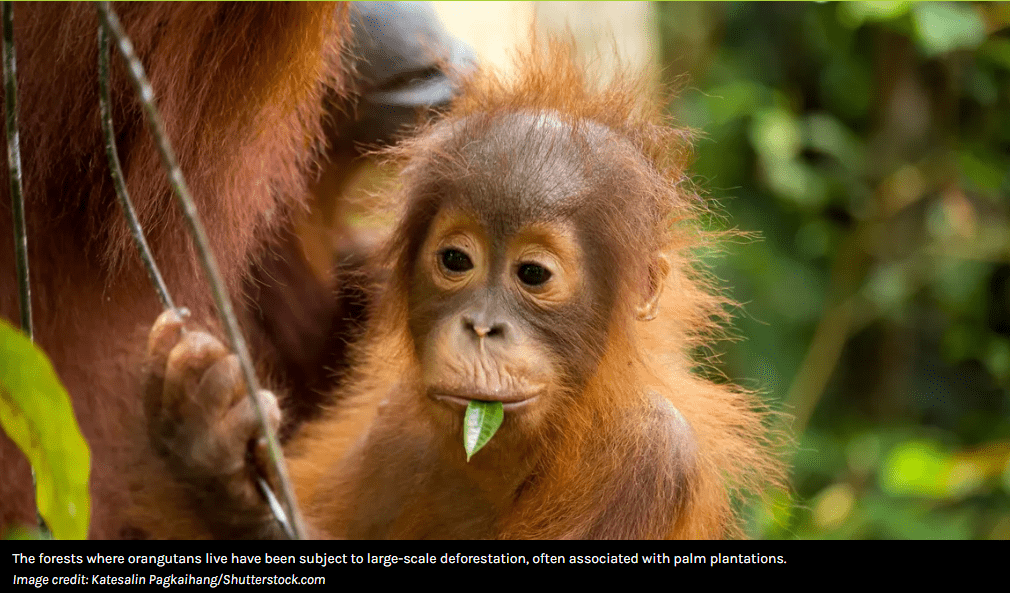
However, the demand for palm oil has also led to large-scale deforestation on the island of Borneo (partly governed by Malaysia), home to the Bornean orangutan. Considered as a critically endangered species, its continuing decline has largely been attributed to the destruction of its forested habitat.
In an effort to combat deforestation and the loss of biodiversity that comes with it, the European Union (EU) last year introduced a law to end the import of products containing palm oil – amongst other commodities – that comes from deforested land. Malaysia, the second-biggest exporter of palm oil in the world, called the law “unjust”.
With Ghani suggesting the EU could be in line to receive an orangutan, the diplomacy plan could be seen as a response to the law’s introduction.
However, the newly announced plan hasn’t gone without criticism.
“It is obscene, repugnant and extraordinarily hypocritical to destroy rainforests where orangutans live, take them away and give them as gifts to curry favor with other nations,” said Stuart Pimm, chair of conservation ecology at Duke University, speaking to CNN. “It totally goes against how we should be protecting them and our planet.”
WWF-Malaysia also released an op-ed in response to the plan, suggesting it wasn’t the best way to go about protecting the species and tackling declining biodiversity.
“WWF-Malaysia is of the opinion that a more effective way for biodiversity and orangutan conservation is through improving forest management, prioritising in-situ orangutan conservation, supporting sustainable palm oil production, and increasing international fundings for conservation efforts in developing countries,” the piece reads.
“Rather than sending orangutans abroad, this approach ensures the survival of the species and promotes responsible conservation practices and sustainable production.”
https://www.iflscience.com/orangutan-diplomacy-malaysias-new-plan-to-give-endangered-primates-to-palm-oil-partners-74547
Sumber : IFLScience
- Details
- Hits: 1002

JAKARTA : Malaysian palm oil futures fell on Monday, weighed down by weakness is rival vegetable oils on the Dalian Commodity Exchange and a firm ringgit
The benchmark palm oil contract for October delivery on the Bursa Malaysia Derivatives Exchange closed down 0.84% to 3,909 ringgit ($843.00) a metric ton.
“Bursa Malaysia palm oil started lower because of tracking spillover weakness from Dalian Commodity Exchange market and firm ringgit,” a Kuala Lumpur-based trader said.
Dalian’s most-active soyoil contract declined 1.08%, while its palm oil contract rose 0.69%. Soyoil prices on the Chicago Board of Trade were down 0.81%.
Palm oil tracks price movements of rival edible oils, as they compete for a share of the global vegetable oils market.
Palm snaps 3-session losing run on strong exports
Malaysian ringgit, the contract’s currency of trade, strengthened 0.39% against the U.S. dollar, making palm oil less attractive for foreign currency holders.
Indonesia’s Trade Ministry is planning to revise the domestic market obligation rules for palm oil to potentially change the prices for the portion and types of product sold to the local market, an official said on Monday. However, market participants are waiting for further details of the revision.
“Indonesia plans to revise palm oil domestic market rules offer little cues as market been talking about it for months. Hence, need further details before can assess the impact of it,” a trader said.
Malaysian palm oil exports for July 1-25 are estimated to have risen from last month, with Cargo surveyor Societe Generale de Surveillance estimateing exports at 1,193,049 metric tons from 908,517 tons during June 1-25, according to LSEG.
Cargo surveyors Intertek Testing Services and Amspec Agri said exports rose 31% year-on-year.
https://www.brecorder.com/news/40314886/palm-oil-declines-weighed-down-by-weaker-dalian-rivals-and-firm-ringgit
Sumber : Business Recorder