-
Official Websites of
-
MINISTRY OF
PLANTATION AND COMMODITIES -
No. 15, Level 5-13, Persiaran Perdana, Presint 2, 62654 Wilayah Persekutuan Putrajaya


ARKIB BERITA
- Details
- Hits: 1610
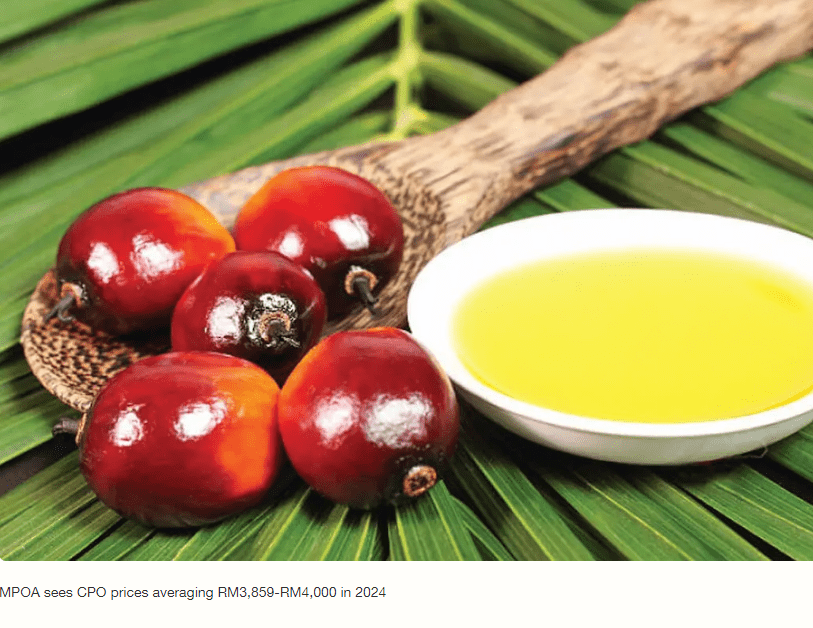
KUALA LUMPUR (July 16): Crude palm oil (CPO) futures for the active months in 2024 are forecast to average between RM3,850 and RM4,000 per tonne on Bursa Malaysia, according to the Malaysian Palm Oil Association (MPOA).
In a statement on Monday (July 15), the association said this projection indicates a slight increase compared to the RM3,800 per tonne average witnessed throughout 2023, reflecting ongoing market dynamics and supply-demand balances in the palm oil sector.
MPOA said that in June 2024, CPO production figures from both the MPOA members and the Malaysia Palm Oil Board (MPOB) mirrored each other closely, with MPOA reporting 1.60 million tonnes and MPOB slightly higher at 1.61 million tonnes.
It said this represented a 5% decrease month on month but a robust 12% increase year on year.
The group said market sentiment points towards a potential total CPO production in 2024 exceeding 19 million tonnes based on Malaysia's first half of 2024 performance, which saw a notable 10% year-on-year increase to 8.88 million tonnes compared to 8.08 million tonnes last year.
It said this growth was predominantly driven by a substantial 19% rise in Peninsular Malaysia, offsetting a 5% decline in Sabah.
However, MPOA said concerns may arise for the second half of 2024, as reduced rainfall in the first half may impact future FFB and corresponding CPO production.
It said the ability of Sabah to bolster production in the latter half of the year will be pivotal in determining if the elusive 19 million-tonne mark can be surpassed.
Outgoing MPOA chief executive Joseph Tek Choon Yee highlighted the sector's distinctiveness, operating primarily in rural settings and relying on and being exposed to natural elements like rainfall and sunlight — and not in any assembly lines under a roof.
He said the oil palm trees are biologically robust and perennial, enduring for up to 25 years once planted.
“However, the sector faces unique challenges: crude palm oil (CPO) is a commodity traded at market prices, making producers price-takers rather than price-makers.
“Consequently, the industry cannot simply pass on rising costs to consumers. Investments are long-term, with returns fluctuating based on palm product prices,” he said.
Tek said the initial gestation period involves around three years with no income, followed by replanting only after more than two decades. The industry remains predominantly labour-intensive, relying heavily on foreign workers due to locals generally not aspiring for the low-skilled "3D" jobs set against no game-changing mechanisation breakthroughs as yet.
“Compounding these challenges are rising production costs, with the national average for CPO currently standing at RM2,800 to RM3,000 per metric ton,” he said.
https://theedgemalaysia.com/node/719148
Sumber : The Edge Malaysia
- Details
- Hits: 333
The Malaysian Palm Oil Board (MPOB) has called for an oil hub or redistribution centre to be set up in Egypt to build on recent cooperation between the two countries, the New Straits Times reported.
MPOB director general Dr Ahmad Parveez Ghulam Kadir was quoted as saying the initiative had mutual benefits and was in line with the countries’ aim to cooperate in investments within the agro-commodities sectors and bulking facilities.
“By leveraging Egypt’s strategic position and ability to re-export to neighbouring countries, Malaysia can consider establishing a hub for Malaysian palm-based downstream products at one of Egypt’s major ports,” Dr Kadir told Business Times.
The proposed hub in Egypt would serve as a vital link in the distribution chain, ensuring timely delivery of palm oil products to markets in the Middle East and North Africa, the 6 June report said.
“This can also encourage small quantity imports by Egyptian industry members directly from Malaysian exporters, thus eliminating the additional cost of dealing with a third party,” Dr Kadir added.
In addition, he said Malaysia could establish its distribution hub in the Suez Canal Economic Zone (SCZONE), to provide facilities to boost the market presence of Malaysian palm-based products in the region.
For this reason, he said the Malaysian oil palm industry could consider investing in bulking facilities in Egypt to gain market share in this region.
"Egypt, with its unique geography, has high potential to be an economic and industrial hub, linking Europe, the Middle East and Africa – a unique trade triangle connected to the world via the Suez Canal,” he said.
https://www.ofimagazine.com/news/mpob-calls-for-setting-up-of-oil-hub-or-redistribution-centre-in-egypt
Sumber : Oil and Fat International
- Details
- Hits: 364
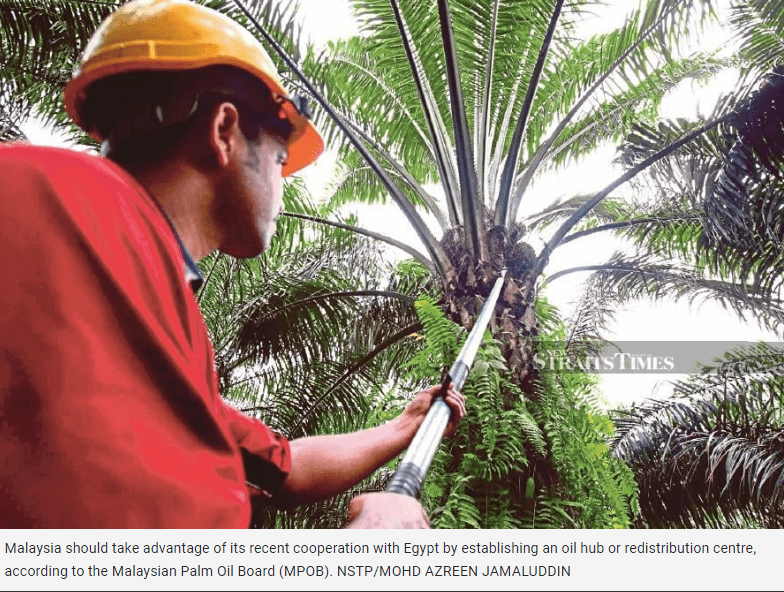
KUALA LUMPUR: Malaysia should take advantage of its recent cooperation with Egypt by establishing an oil hub or redistribution centre, according to the Malaysian Palm Oil Board (MPOB).
Its director-general Datuk Dr Ahmad Parveez Ghulam Kadir emphasised the mutual benefits of the initiative, highlighting the promising results from the current mission, which underscored both nations' eagerness to cooperate in investments within the agro-commodities sectors and bulking facilities.
"By leveraging Egypt's strategic position and ability to re-export to neighbouring countries, Malaysia can consider establishing a hub for Malaysian palm-based downstream products at one of Egypt's major ports.
"This will enable us to provide the required palm-based downstream products to the industry promptly and efficiently," Ahmad Parveez told Business Times.
The proposed hub in Egypt would serve as a vital link in the distribution chain, ensuring timely delivery of palm oil products to markets in the Middle East and North Africa.
"This can also encourage small quantity imports by Egyptian industry members directly from Malaysian exporters, thus eliminating the additional cost of dealing with a third party," said Ahmad Parveez.
In addition, Ahmad Parveez said Malaysia could establish its distribution hub in the Suez Canal Economic Zone (SCZONE), which provides facilities that could enhance the market presence of Malaysian palm-based products in the region.
Therefore, he said the Malaysian oil palm industry could consider investing in bulking facilities in Egypt to gain market share in this region.
"Egypt, with its unique geography, has high potential to be an economic and industrial hub, linking Europe, the Middle East and Africa - a unique trade triangle connected to the world via the Suez Canal.
"Additionally, Egypt is a key participant in some of the world's most prominent trade agreements such as African Continental Free Trade Area, the Common Market for Eastern and Southern Africa and Egypt Free Trade Agreement, to name a few," he said.
Moving forward, Ahmed Parveez said Malaysia should explore investing in higher-value retail products of the downstream sector in Egypt.
This can be achieved through partnership arrangements and strategic alliances with local partners in the market.
"These initiatives could be joint efforts between Malaysian palm oil stakeholders and the Egyptian Businessmen's Association (EBA), enhancing and strengthening the importance of the oil palm industry and other commodities like timber and rubber in contributing to Egypt's economic and social development productivity," he added.
Plantation and Commodities Minister Datuk Seri Johari Abdul Ghani recently led a Malaysian delegation to Egypt and Turkiye for a working visit from May 27 to June 1.
In Cairo, he was received by Egypt's Supply and Internal Trade Minister Dr Ali El Moselhi.
During his visit, Johari discussed with Dr Ali to strengthen bilateral cooperation between the two countries as well as business leaders in the palm oil industry.
He said Egypt will remain Malaysia's key trading partner as the government sets to expand its palm oil exports to South Africa and the Middle East.
""I am confident that Egypt's strategic geographical location would enhance our nations' economic prosperities.
"In our discussions, I emphasised to the Egyptian government regarding Malaysia's commitment to providing Egypt with a steady supply of high quality and sustainable palm oil certified by our locally-developed certification standard, MSPO.
"I look forward to further cooperating with His Excellency Dr Ali to ensure mutually beneficial trade relations," he said in a posting on X.
https://www.nst.com.my/business/corporate/2024/06/1059914/mpob-calls-setting-oil-hub-redistribution-centre-egypt#google_vignette
Sumber : New Straits Times
- Details
- Hits: 582

KUALA LUMPUR: The Malaysian Palm Oil Board (MPOB) has urged palm oil industry players to grasp the golden opportunity to export palm tocotrienol products to China after obtaining the approval to register the product in the republic recently.
Following the approval received on March 13, palm tocotrienol (Vitamin E) is now authorised for export and use in food applications within China.
MPOB director-general Datuk Dr Ahmad Parveez Ghulam Kadir said the approval also gave the opportunity to industry players to capitalise the potential to significantly strengthen their market presence and revenue in one of the world’s largest markets.
"This approval is one of the best gifts awarded by the Chinese Government to the Malaysian oil palm industry in conjunction with the 50th anniversary celebration of the diplomatic ties between Malaysia and China, symbolising a strong and enduring friendship as well as mutual respect and cooperation," he said in a statement.
Additionally, the approval underscores the commitment and relentless pursuit of excellence by the Malaysian palm oil sector in adhering to international health and safety standards.
It also exemplifies the strategic collaboration between government bodies and industry players in navigating the complexities of global market access and regulatory approvals.
The approval of the palm tocotrienol products registration not only opens new avenues for the Malaysian palm oil industry to penetrate the Chinese market but also has the potential to bring significant positive impacts to Malaysia's economy, said MPOB.
"The increased export of tocotrienols to China could lead to a substantial boost in the nation's revenue, contributing to economic growth and sustainability in the agricultural sector."
MPOB added that the agency together with industry players remain committed to leveraging the opportunity to enhance the visibility and acceptance of Malaysian palm oil products in China and beyond, ensuring the continued growth and sustainability of the industry. - Bernama
https://www.thestar.com.my/business/business-news/2024/04/04/mpob-urges-palm-oi-industry-players-to-export-tocotrienol-products-to-china
Sumber : The Star
- Details
- Hits: 2393
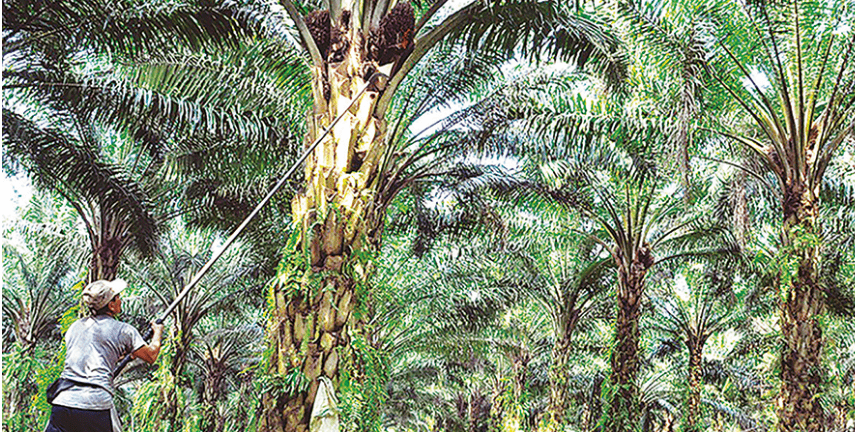
SOME 4.94 million ha, or 87.4%, of the palm oil plantations in Malaysia, and 407 of the 446 palm oil mills have been certified under the Malaysian Sustainable Palm Oil (MSPO) standard as of April this year.
Plantation Industries and Commodities Minister Datuk Seri Johari Abdul Ghani said 151,152 smallholders, covering 542,215 ha (66%), have also obtained certification during the same period.
This represents the collective efforts of the government and industry players over the past decade to enhance the sustainability standards of the industry, according to his speech which was read by his Deputy secretary general (strategic planning and management) Abdul Hadi Omar at the MSPO 10th anniversary celebration and Aidilfitri celebration today.
In addition, the certification has received various recognitions and has signed several memorandums of understanding (MOUs) with stakeholders in key purchasing countries like Japan, China, India, Mongolia and the Philippines.
“A significant MOU was also signed with the Halal Development Centre to promote Malaysian palm oil in the global halal market,” he shared.
Moreover, he said during bilateral discussions with the European Union (EU) on the EU Deforestation-free Regulation and MSPO, positive feedback was received regarding Malaysia’s efforts to reduce deforestation rates.
“The EU has significantly acknowledged Malaysia’s dedication to sustainable commodity production,” he added.
The ministry also announced the rebranding of the Malaysian Palm Oil Certification Council (MPOCC) to MSPO to strengthen the certification scheme’s global standing as a top-quality sustainable palm oil certification scheme.
Johari also unveiled a comprehensive Strategic MSPO Action Plan for 2024 to 2026 to enhance the promotion of the MSPO, focusing on 57 strategic initiatives grouped under three key strategies:
Establishing a solid and reliable certification scheme, enforcing industry compliance while enriching the MSPO certification and broadening the scheme’s recognition and acceptance globally.
“This plan marks a significant step in our commitment to elevating the MSPO to new heights of global excellence and acceptance,” he said.
These efforts are part of ongoing improvements to the MSPO, including traceability, deforestation-free products, legitimate land ownership, and fair labour practices.
The minister repeatedly stressed the need for MSPO to actively engage in local and international forums discussing sustainability or the cooking oil industry and to involve stakeholders in effective engagement sessions.
Lastly, Johari affirmed the importance of placing the MSPO logo on all certified palm oil products to enhance the certification’s reliability and counteract negative perceptions of the industry.
He expressed confidence in Malaysia’s ability to produce high-quality palm oil with premium value while maintaining competitive standards globally.
https://themalaysianreserve.com/2024/05/13/mspo-certification-achieves-87-4-coverage-of-malaysian-palm-oil-plantations/
Sumber : The Malaysian Reserve