-
Official Websites of
-
MINISTRY OF
PLANTATION AND COMMODITIES -
No. 15, Level 5-13, Persiaran Perdana, Presint 2, 62654 Wilayah Persekutuan Putrajaya


ARKIB BERITA
- Details
- Hits: 296

KUALA LUMPUR: The plantation and commodities ministry and the Council of Palm Oil Producing Countries (CPOPC) plan to further strengthen the collaboration between Malaysia and Indonesia for the benefit of the palm oil industry in both countries.
Following a visit from the CPOPC today, plantation and commodities minister Johari Ghani said the matters discussed included disseminating information to the world on the high standards in palm oil production in Malaysia and Indonesia.
“Palm oil production is vital to Malaysia’s economy, and we are the second-largest producer globally after Indonesia,” he said in a post on X.
Johari said the CPOPC’s efforts were among the strategies to promote Malaysia’s palm oil industry and make the commodity the global vegetable oil of choice.
“This is also to ensure that the global community is aware of the benefits of palm oil,” he said.
On Monday, Egyptian ambassador Ragai Tawfik Said Nasr visited Johari to discuss making Egypt a gateway to expand Malaysia’s palm oil exports to Africa through the Suez Canal Economic Zone.
The minister said the governments of both countries were exploring a partnership in marketing palm products, with the involvement of private players.
https://www.freemalaysiatoday.com/category/nation/2024/02/08/malaysia-indonesia-to-strengthen-cooperation-in-oil-palm-industry/
Sumber : Free Malaysia Today
- Details
- Hits: 252
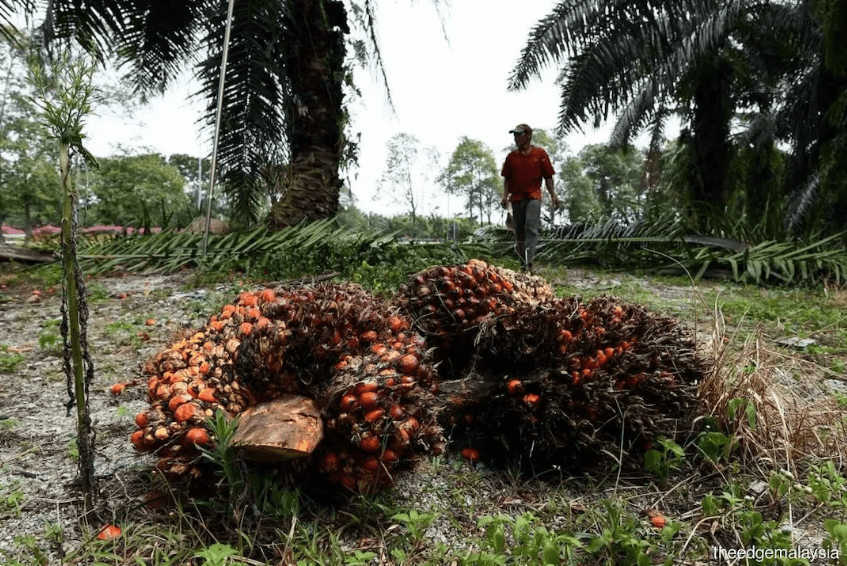
KUALA LUMPUR (June 11): Malaysia’s stockpile of palm oil may continue to swell in the coming months on seasonal strength in production and weigh on prices, analysts cautioned.
At least seven research houses maintained their neutral view on the plantation sector following the release of palm oil stocks data by the Malaysian Palm Oil Board (MPOB) that showed a 0.5% month-on-month expansion in inventory for May.
Output will likely peak at the end of June or by the third quarter, supported by improving weather conditions and productivity, BIMB Securities said. Demand could be subdued as palm oil is still trading at a small discount against more expensive substitute soybean oil, the research house said.
Prices of the edible oil used in everything from lipstick to diesel have climbed about 5% so far this year as poor weather conditions in key producing nations Malaysia and Indonesia stoked concerns over output and potential tightening in supply.
The benchmark palm oil contract for August delivery was trading at around RM3,887 per tonne on Bursa Malaysia Derivatives on Tuesday. However, prices are down 12% from a high of RM4,407 per tonne on April 3.
Further, strong shipments in May are at risk from Indonesia's move to cut palm oil-related tariffs in June, which will reduce the export tax to US$18 (RM84.99) per tonne and the levy to US$75 per tonne. All in all, the move could lower export costs by US$49 per tonne compared to the previous month.
Malaysia is losing competitiveness in palm oil exports, TA Securities warned. If production stays at its current robust pace, it would lead to burgeoning palm oil stockpiles and potentially limit the upside, the research house said.
TA Securities would also review its current forecast for crude palm oil to average RM4,000 per tonne in 2024 if South America's soybean supply turns out to be lower than expected, demand recovers more meaningfully, and production costs fall significantly.
MPOB data released on Monday showed palm oil inventory totalling 1.75 million tonnes in May in the world’s largest palm oil producing nation after Indonesia, as higher exports and domestic consumption were more than offset by higher output.
Production surged 13.5% from April to 1.70 million tonnes in May, the biggest in six months. Exports, meanwhile, rose to a six-month high of 1.38 million tonnes, up 11.66% from April, the MPOB said.
For strategy, MIDF Amanah Investment Bank said now is the best time for investors to lock in profits for its top picks, such as Ta Ann Holdings Bhd (KL:TAANN) and IOI Corp Bhd (KL:IOICORP), "as we anticipate the increase in share price will gradually decline towards the end of the quarter”.
TA Securities, BIMB, and MIDF have a ‘neutral’ outlook on the sector.
https://theedgemalaysia.com/node/715012
Sumber : The Edge Malaysia
- Details
- Hits: 335


KUALA LUMPUR/MUMBAI: Malaysia's palm oil stocks at the end of March dropped to their lowest in 10 months as a jump in exports offset a rebound in production, the industry regulator said on Monday.
The reduction in stocks in Malaysia, the world's second-largest palm oil producer after Indonesia, would help in supporting benchmark futures, which rose to a one-year high earlier this month.
Malaysia's palm oil stocks at the end of March fell 10.68% from the previous month to 1.71 million metric tons, their lowest since May, data from the industry regulator the Malaysian Palm Oil Board (MPOB) showed.
Crude palm oil (CPO) production gained 10.57% from February to 1.39 million tons, while palm oil exports ticked up 28.61% to 1.32 million tons, the MPOB said.
A Reuters survey forecast March inventories at 1.79 million tons, a 6.65% decline from the previous month, with output at 1.38 million tons and exports at 1.23 million tons.
The MPOB report is bullish for the market, Anilkumar Bagani, research head of vegetable oils broker Sunvin Group said.
"The CPO stocks are depleting fast, and they could fall further by end of April. Malaysian output could drop in the first half of April because of Ramadan holidays, while exports during the period were higher than the last month," he said.
The CPO stocks at the end of March fell to 797,974 tons, the lowest since March 2022, the MPOB data showed.
As soybean oil exports from South America are set to increase in the coming months, palm oil exports could come under pressure, a New Delhi-based trader said.
This is because soybean oil is trading at a discount to palm oil, which will cap palm oil prices despite falling stocks, the trader said.
Palm oil is affected by price movements in related oils as they compete for a share in the global vegetable oils market.
Following is a breakdown of the Malaysian Palm Oil Board figures and Reuters estimates for March (volumes in tons): - Reuters
https://www.thestar.com.my/business/business-news/2024/04/15/malaysia039s-palm-oil-stocks-fall-to-10-month-low-as-exports-surge
Sumber : The Star
- Details
- Hits: 723

KUALA LUMPUR (Jan 24): Palm oil output in Malaysia, the number two supplier, could rise 5% this year after the government allowed plantations to hire foreign workers, said Joseph Tek, chief executive of the Malaysian Palm Oil Association.
The admission of new workers potentially means that an additional 5.2 million tonnes of fresh fruit bunches can be harvested, the top growers’ group said in a statement. That translates into 1 million tonnes of crude palm oil, Tek said.
The extra tonnenage would also generate revenue of close to RM4 billion, bringing “significant relief” to the industry, which is grappling with a substantial shortage of 40,000 workers, the group said. The news pressured benchmark palm oil futures in Kuala Lumpur trading.
The government has been trying to reduce reliance on cheap foreign labor across many industries including manufacturing, construction and plantations, and seeks to regulate admission processes to prevent any issues like forced labor, worker exploitation and human trafficking.
In March last year, the country temporarily suspended the application and approval process for foreign workers under a quota system in order to speed up the entry of workers already approved.
Chronic shortage
Malaysia’s palm oil industry is heavily reliant on foreign labour. A chronic shortage of workers resulted in revenue losses estimated at RM20 billion in 2022 and continued to curb growth in output last year.
Palm oil production in Malaysia totaled 18.55 million tonnes in 2023, and earlier this month the Palm Oil Board, which regulates the industry, predicted output of 18.75 million tonnes for this year. That’s less than half the supply from top producer Indonesia, where output has expanded steadily in recent years.
The association represents over 40% of the oil palm area in Malaysia. Members include some of the top plantation companies such as Sime Darby Plantation Bhd, Kuala Lumpur Kepong Bhd, IOI Corp and FGV Holdings Bhd.
Palm oil futures in Kuala Lumpur climbed as much as 0.9% to RM3,985 a tonne on Wednesday, before paring gains to RM3,955 by midday.
The higher output estimate is capping the rally, said Gnanasekar Thiagarajan, head of trading and hedging strategies at Kaleesuwari Intercontinental. The move to allow more foreign workers “adds to supply woes,” he said.
https://theedgemalaysia.com/node/698490
Sumber : The Edge Malaysia
- Details
- Hits: 382

KUALA LUMPUR – A Malaysian minister’s proposal to send orang utans as gifts to countries that buy its palm oil in a bid to show “commitment to biodiversity conservation” has been panned by environmentalists and wildlife groups, who said the government should focus on deforestation.
Instead of shipping the endangered apes to trading partners like India, China and the European Union, the Malaysian government should do more to show its palm oil is produced sustainably, they said.
The “orang utan diplomacy” proposal from Plantation and Commodities Minister Johari Abdul Ghani comes on the heels of a landmark EU regulation requiring companies selling deforestation-linked goods in Europe to prove that these products are not derived from deforested lands or linked to forest degradation.
“In adopting orang utan diplomacy, we aim to demonstrate Malaysia’s unwavering commitment to biodiversity conservation,” he said in a post on his X account last week, likening the strategy to China’s “panda diplomacy” as a form of soft power.
“It would be a... strategy, where we will gift orangutans to trading partners and foster foreign relations, especially with major importing nations like the European Union, India and China,” he said.
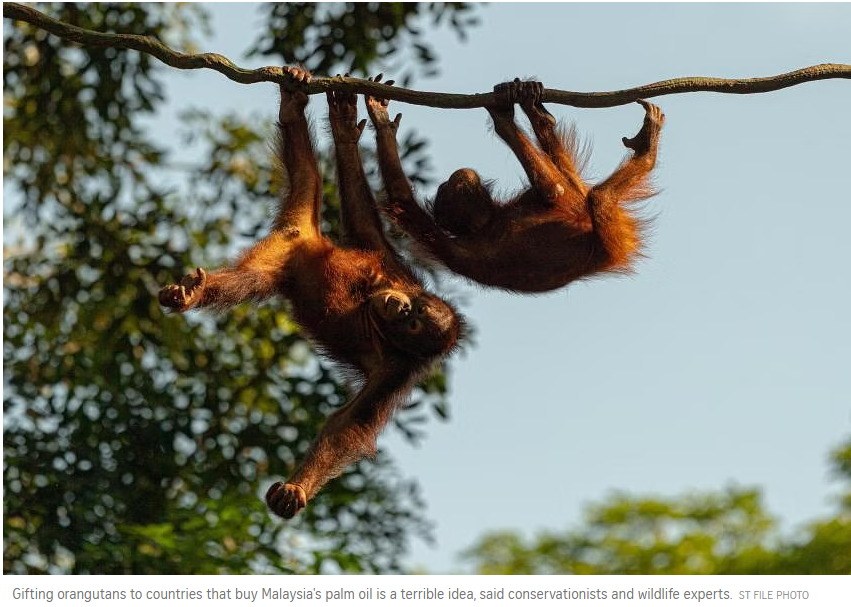
Gifting orang utans to countries that buy Malaysia’s palm oil is a terrible idea, said conservationists and wildlife experts, adding that palm-oil cultivation has been one of the biggest factors behind the apes’ dwindling numbers.
“It’s nonsense and the minister knows it,” said Ms Michelle Desilets, executive director of Britain-based Orangutan Land Trust. “West Malaysia has no say over orang utans which live only in Sarawak and Sabah,” in addition to Kalimantan and Sumatra in Indonesia, she said in response to Datuk Seri Johari’s proposal.
The Borneo orang utan and the Sumatra orang utan are listed as critically endangered by the International Union for Conservation of Nature.
It is believed that 100 years ago there were probably more than 230,000 orang utans in total, but the Borneo orang utan’s population is thought to be about 104,700, while the Sumatra orang utan is thought to number about 7,500, according to conservation group WWF.
More can be done to ease concerns about the environmental impact of palm-oil production, conservationists said.
While Malaysia has made strides in ensuring its palm oil is sustainably produced, Ms Desilets said the industry is still a significant driver of deforestation.
“Real diplomacy can be shown by ensuring the global buyers that Malaysian palm oil is indeed sustainable and deforestation-free, and also that they are serious about the conservation of orang utans in situ,” she told The Straits Times.
Malaysia is the second-biggest producer of palm oil in the world, after Indonesia. The export of Malaysia’s palm oil and palm-oil based products is projected to be worth about RM110 billion (S$31.5 billion) in 2024, said Bursa Malaysia chairman Wahid Omar at an industry conference in March.
The two South-east Asian countries account for around 85 per cent of the world’s palm oil products, which can be found in everything from pizza and ice cream to lipstick and shampoo.
Global demand for palm oil has been blamed for driving deforestation in Malaysia and Indonesia, and harming wildlife habitats there.
Last year, the EU approved an import ban on commodities linked to deforestation, a move that Malaysia has criticised as discriminatory.
Importers will have until the end of 2024 to comply with the new EU ruling, which came into force in June 2023.
Wildlife organisations urged the Malaysian government to consider other ways to show its commitment to biodiversity and protecting the great apes, such as by preserving the forests where they live.
WWF-Malaysia, for one, noted that orang utans are slow breeders and taking female simians out of the country to a strange and unnatural environment may adversely impact the orang utan population.
“The conservation of orang utans is best achieved by ensuring the protection and conservation of their natural habitats, and no further forest conversion into oil palm plantations allowed,” it said in a statement to ST.
Malaysia should improve the connectivity of fragmented orang utan habitats and this can be done by getting oil palm plantations to set aside wildlife corridors that are safe for orang utans, WWF-Malaysia added.
Datuk John Payne, chief executive of the Borneo Rhino Alliance, agreed that the orang utans should remain in their natural habitat, but welcomed new ideas on saving the endangered apes.
“One possible way to approach orang utan diplomacy that would not raise awkward criticism might be to garner support from the Malaysian palm oil-buying nations to collaborate with the Malaysian oil palm growers in sustaining that wild population in situ, where they are,” Dr Payne said.
There is a well-established wild orang utan population living and reproducing in the mixed oil-palm and forest landscape in eastern Sabah between Sandakan and Lahad Datu, he added.
Datuk Darrel Webber, former CEO of the Malaysia-based Roundtable on Sustainable Palm Oil, which was set up to develop and implement global standards for certified sustainable palm oil, said there are ready examples to look to for a softer approach involving orang utans and making the case for sustainable palm oil.
World-class zoos like those in Singapore, London and Auckland run regular campaigns to raise awareness about the orang utans and to highlight the value of choosing products made with sustainable palm oil to help protect the rainforests, thus making a positive impact on the environment, he said.
“I would humbly suggest that the minister approach these sorts of organisations (zoos), which enjoy a high degree of trust among their countrymen, to help with the diplomatic aims he seeks,” Mr Webber said.
Plantation and Commodities Minister Johari did not respond to ST’s request for comments on the matter.
Correction note: In an earlier version of the story, we said that Datuk John Payne was executive director of the Borneo Orangutan Rescue Alliance. This is incorrect. It should be chief executive officer of the Borneo Rhino Alliance. We are sorry for the error.
https://www.straitstimes.com/asia/se-asia/malaysia-s-plan-to-gift-orangutans-to-countries-buying-palm-oil-panned-by-green-groups
Sumber : The Straits Times