-
Official Websites of
-
MINISTRY OF
PLANTATION AND COMMODITIES -
No. 15, Level 5-13, Persiaran Perdana, Presint 2, 62654 Wilayah Persekutuan Putrajaya


ARKIB BERITA
- Details
- Hits: 279

KUALA LUMPUR: Malaysia's palm oil stocks at the end of March fell 10.68 per cent from the previous month to 1.71 million metric tons, data from the industry regulator showed on Monday.
Crude palm oil production gained 10.57 per cent from February to 1.39 million tons, while palm oil exports ticked up 28.61 per cent to 1.32 million tons, said the Malaysian Palm Oil Board (MPOB).
A Reuters survey forecast March inventories at 1.79 million tons, a 6.65 per cent decline from the previous month, with output at 1.38 million tons and exports at 1.23 million tons. - Reuters
https://www.nst.com.my/business/corporate/2024/04/1038010/malaysia-end-march-palm-oil-stocks-fall-1068pc-says-mpob
Sumber : New Straits Times
- Details
- Hits: 603
Petaling Jaya : Malaysia has secured the backing of India, the world’s largest palm oil importer, in combating the anti-palm oil campaign propagated by Western nations.
At a roundtable in New Delhi yesterday attended by plantation and commodities minister Johari Ghani, the Indian Vegetable Oil Producers Association (IVPA) voiced unequivocal support for Malaysia’s stand.
Johari was on a two-day trip to the Indian capital city from July 17 to 18.
IVPA president Sudhakar Desai said the ongoing anti-palm oil campaign poses a threat to the commodity, an essential good for the 1.4 billion consumers in India.
He called for targeted campaigns in response, aimed at shining light on the sustainability and economic benefits of palm oil, to combat concerns of climate change and deforestation.
Another approach, Sudhakar said, would be to work with think tanks and research institutions to highlight unbiased studies about the commodity.
The findings of these studies should then be used as part of marketing and advocacy campaigns to build the trust of consumers in palm oil, the head of the association in India said.
Speaking at the roundtable’s dialogue session, Johari said palm oil was the most efficient edible oil in terms of productivity and land use.
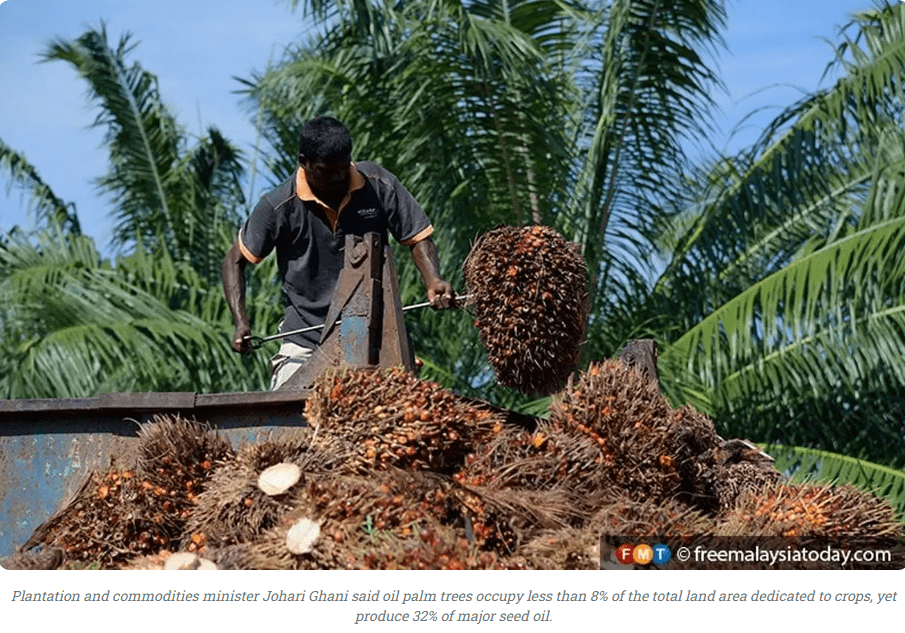
He said oil palm trees occupy less than 8% of the total area of land dedicated to crops, yet produce 32% of major seed oil.
Due to its low cost, high-yielding nature and consistent availability, palm oil boasts the highest yield among vegetable oils, producing 3.3 tonnes per hectare of oil compared to soybean (0.5), sunflower (0.8), and rapeseed (0.8), he said, according to a press release.
Johari said India would continue to be a key trade partner for Malaysia, which remains committed to supplying the South Asian country with high quality and sustainably produced palm oil.
The European Union Deforestation-free Regulation (EUDR) introduced in November 2021 is aimed at limiting deforestation caused by the consumption of agricultural commodities and products around the world.
The EUDR lists palm oil as one of the commodities that drive deforestation and forest degradation through the expansion of agricultural land.
In April, Johari urged the EU to end its arbitrary and unjustifiable discrimination against palm oil
, and to act fairly in enforcing its strict environmental and sustainability laws and targets.
Yesterday, the minister said Malaysia’s palm oil exports to India would continue to rise in line with the growth of India’s middle-class consumer base.
Malaysia’s exports of palm oil and palm oil products to India last year totalled 3.3 million tonnes, valued at US$3 billion (RM14 billion), or 13% of Malaysia’s total palm oil exports.
https://www.freemalaysiatoday.com/category/nation/2024/07/19/malaysia-gets-indias-backing-in-fight-against-anti-palm-oil-campaign/
Sumber : Free Malaysia Today
- Details
- Hits: 469
KUCHING: Malaysia is on the right track to obtain the European Union’s (EU) "green light” in the near term for the recognition of the Malaysian Sustainable Palm Oil (MSPO) certification scheme, says Deputy Prime Minister Datuk Seri Fadillah Yusof.
Fadillah, who is also the Energy Transition and Water Transformation Minister, said the EU leadership is expected to make the announcement by June at the latest.
"We want MSPO to be recognised so that our smallholders are not left out or marginalised following the implementation of the EU Deforestation Regulation (EUDR).
"This is good news. With our MSPO being recognised by the EU, locally-produced commodity products would not be required to be audited by them,” he told reporters after the 2024 annual grant handover ceremony for the Petra Jaya federal constituency’s village development and security committees (JKKKs) here today.
He said this was shared during a brainstorming session with an EU delegation that has been in the state since last Wednesday for the launch of Invest Sarawak and Business Day programme.
In May last year, Fadillah, who was then holding the Plantation and Commodities Minister portfolio, jointly led a mission to Brussels, Belgium, to convey the stance of the Council of Palm Oil Producing Countries (CPOPC) members on the EUDR implementation.
As a CPOPC member, he said, Malaysia is committed to be involved actively through the platform and continue the agenda of countering Western countries’ negative campaigns against palm oil.
At the ceremony on Saturday (Feb 17), Fadillah, who is also the Member of Parliament for Petra Jaya, presented grants totalling RM255,000 to 85 JKKKs under his constituency. - Bernama
https://www.thestar.com.my/news/nation/2024/02/18/malaysia-on-right-track-for-mspo-recognition-from-eu-says-fadillah
Sumber : The Star
- Details
- Hits: 379
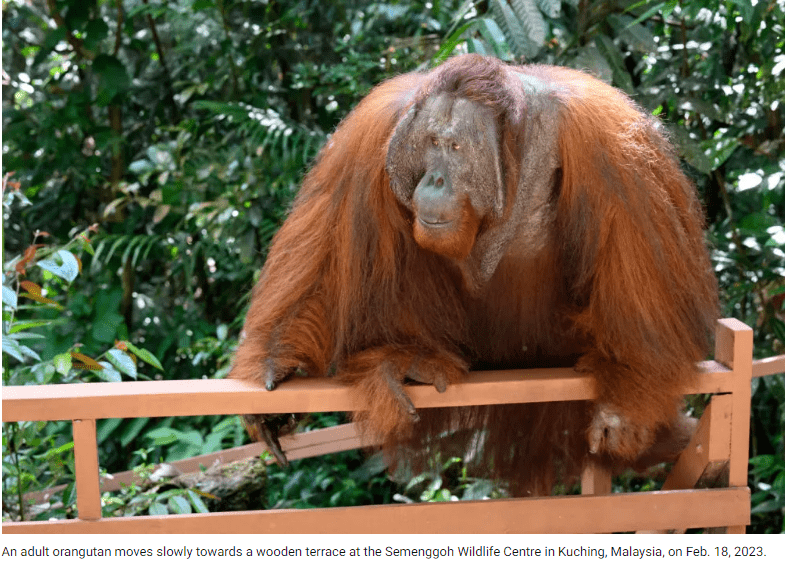
Malaysia plans to gift orangutans to its major buyers of palm oil, a commodity long blamed for destroying habitats of the endangered apes.
The world’s second-biggest palm grower is taking inspiration from China’s “Panda Diplomacy,” and is considering to gift the orange-haired mammals to some of its trading partners, including the European Union, as part of the country’s “strategic diplomatic move.”
“This will be a manifestation of how Malaysia preserves wildlife and ensures sustainability of our forests, especially within the palm oil plantation landscape,” Johari Abdul Ghani, the Southeast Asian nation’s plantations and commodities minister, said in a post on X. The move will prove to the world that Malaysia is committed to biodiversity conservation, he said.
The idea follows accusations and restrictions by some palm oil importers, such as Europe, that its cultivation destroys rainforests, drives endangered animals toward extinction, and is linked to labor abuse. Environmental groups have stepped up scrutiny of the crop, while the EU is introducing rules to stop products that cause deforestation from being sold in shops.
“Malaysia must not take a defensive stance on palm oil,” Johari said. “Instead, we have to show the world that Malaysia is a producer of sustainable palm oil and is committed to safeguard forests as well as environmental sustainability.”
Indonesia and Malaysia, the world’s top palm oil producers that collectively account for about 85% of global output, have pledged to work together to counter “anti-palm oil campaigns” launched by some western countries. Palm oil is a versatile ingredient found in products such as pizza, instant noodles, and shampoo.
Orangutans are found in the rainforests of the Southeast Asian islands of Borneo and Sumatra, according to the World Wildlife Fund. The great apes are critically endangered — with their population estimated at about 120,000 — and threatened by rapid deforestation mainly due to palm oil and other agriculture plantations, the organization said.
https://time.com/6976275/malaysia-orangutan-diplomacy-palm-oil-china-panda/
Sumber : TIME
- Details
- Hits: 2071

BANGI: The government, through the Ministry of Finance and Agriculture and Commodities Ministry, has established a special fund for the Smallholder Palm Oil Replanting Financing Incentive Scheme (TSPKS 2.0).
Plantations and Commodities Minister Datuk Seri Johari Abdul Ghani said the scheme, which involves an allocation of RM100 million, will be fully distributed by Agrobank for the replanting of oil palm, specifically benefiting palm oil entrepreneurs and individual smallholders.
Applications are open starting from Jan 15 and the forms can be obtained from any nearby Tunas/Agrobank office in the smallholder's area.
"The provided funds consist of a grant component (50 per cent) and another part is financing (50 per cent) for individual smallholders.
"The disbursement of funds for both the grant and financing components will be entirely handled by Agrobank.
"However, the repayment by applicants will only involve 50 per cent (including two per cent interest) of the total disbursed amount.
"This initiative aims to benefit private small oil palm planters with a total land area of 5900 hectares," he said at a press conference during the Malaysian Palm Oil Board's Excellence Awards 2023 in Bangi today.
According to Johari, the financing amount is RM14,000 per hectare for small oil palm planters in Peninsular Malaysia, and RM18,000 per hectare for small oil palm planters in Sabah and Sarawak.
The financing is in a combination of grants and funding for the following activities, namely the preparation of planting areas, purchase of high-quality oil palm seedlings, and the maintenance of the plantation until the oil palms reach three years of age (36 months) after planting.
On that note, Johari said the government is committed to ensuring the long-term economic viability of the palm oil industry.
He added that his ministry's main focus has been to engage with all stakeholders in this sector to identify and address specific issues affecting the country's palm oil performance.
"Besides labour, a primary focus for industry players, issues such as plantation management, palm replanting, and timely fruit harvesting are emphasised.
"Research and development (R&D) efforts have the potential to enhance the overall productivity of the palm oil industry.
"Furthermore, mechanisation and automation can improve labour efficiency and overall productivity," he noted.
Johari also highlighted that the global demand for palm oil is expected to increase with the growing world population.
He said considering limited resources, Malaysia, as the world's second-largest palm oil producer, must seize this opportunity by enhancing productivity and production.
"The global food security issue urges countries like Malaysia to boost productivity in agricommodity production to meet the rising demand," he said.
https://www.nst.com.my/business/corporate/2024/01/1004953/malaysia-sets-rm100mil-fund-smallholders-replant-palm-oil
Sumber : New Straits Times