-
Official Websites of
-
MINISTRY OF
PLANTATION AND COMMODITIES -
No. 15, Level 5-13, Persiaran Perdana, Presint 2, 62654 Wilayah Persekutuan Putrajaya


ARKIB BERITA
- Details
- Hits: 654

In a statement, Doppa president Napoleon R Ningkos said the association is willing to help enable the expeditious surveying of their NCR land. — Picture by Mukhriz Hazim
MIRI, Jan 16 — Sarawak Dayak Oil Palm Planters Association (Doppa) members say they are willing to pay for Native Customary Rights (NCR) land surveys to expedite the state government’s efforts and enable the early issuance of perpetuity land titles.
In a statement, Doppa president Napoleon R Ningkos said the association is willing to help enable the expeditious surveying of their NCR land.
He proposed the Land and Survey Department allow government-registered private land surveyors to survey verified NCR land planted with oil palm or other cash crops.
"The costs and expenses of engaging these private registered land surveyors will be borne by the Doppa members,” he said.
Napoleon suggested this effort would complement the state government’s new NCR initiative with the amendment of Section 6 of the Land Code, 1958, a move welcomed by the association.
Under this amendment, NCR lands are identified upon receiving the community’s application and surveyed for gazettement under Section 6A.
The claiming native community then jointly applies for the issuance of titles to the said lands under Section 18 for native titled lands in perpetuity.
According to Doppa, surveying of NCR land under this new initiative via the Land and Survey Department may take a long time, involving manpower and logistics.
"Many of the applying communities have not received any reply to their applications,” he said.
He pointed out having titles for Doppa land is crucial for areas planted with oil palm or other cash crops, and it is a criteria required for bank financing purposes, Malaysian Palm Oil Board licences, Malaysian Sustainable Palm Oil certification, and foreign worker approved in principle applications.
Doppa pointed out there is urgency for land titles due to the recent federal government announcement that oil palm replanting initiatives or grants may also require titles.
It added that several years ago, the Ministry of Food Industry, Commodity and Regional Development had through its One-Stop Centre initiated a programme whereby Doppa members could apply through the ministry for NCR status verification of their planted lands.
However, Doppa said less than 10 per cent of the applicants had their lands verified to reap the benefits. — Borneo Post
https://www.malaymail.com/amp/news/malaysia/2024/01/16/in-sarawak-dayak-oil-palm-planters-say-willing-to-pay-for-ncr-land-surveys-to-speed-up-process/112701
Sumber : Malay Mail
- Details
- Hits: 1278
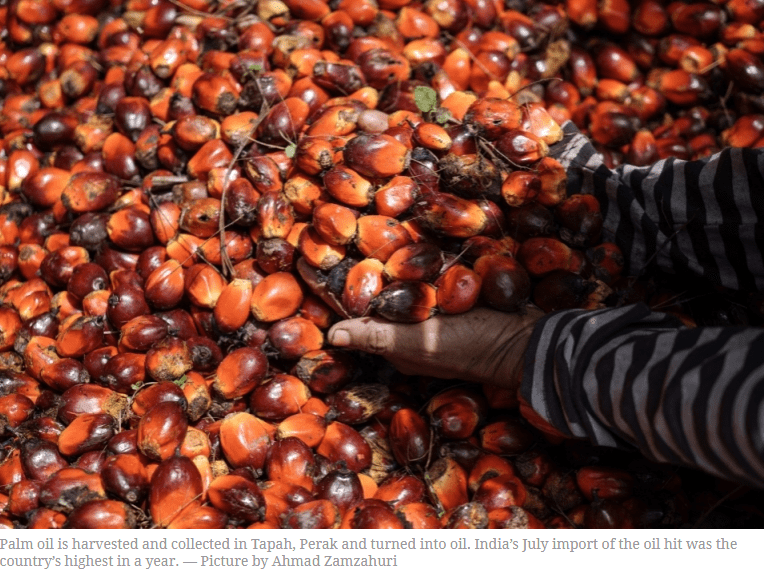
MUMBAI, Aug 2 — India's palm and soybean oil imports surged to their highest levels in about a year in July, as refiners increased purchases following a price correction and in anticipation of a potential import duty hike, six dealers said on Friday.
Higher palm oil purchases by the world's biggest importer of vegetable oils will help reduce inventories in top producers Indonesia and Malaysia and support benchmark prices.
Palm oil imports surged 39 per cent in July from the previous month to 1.09 million metric ton, the highest since August 2023, according to estimates from dealers.
The refining margin was positive for palm oil in May and June, during which most buyers placed orders for July shipments, said Rajesh Patel, managing partner at edible oil trader and broker GGN Research.
Soy oil imports in the month jumped 43 per cent to 394,000 metric tons, the highest in 13 months, dealers said.
The imports also got a boost from expectations of a duty hike in the budget, which encouraged buyers to increase purchases, said Sandeep Bajoria, CEO of Sunvin Group, a vegetable oil brokerage.
Last week, Finance Minister Nirmala Sitharaman presented the budget for the 2024-25 financial year, although she didn't make any changes to the duty structure on edible oils.
India buys palm oil mainly from Indonesia, Malaysia and Thailand, while it imports soyoil and sunflower oil from Argentina, Brazil, Russia and Ukraine.
Sunflower oil imports fell 22 per cent in July from the previous month's record shipments to 364,000 metric tons, dealers said.
A surge in imports of palm oil and soy oil lifted the country's total edible oil imports by 21 per cent to 1.85 million tons, the second highest on record, as per dealers' estimate.
India on average has been importing 1.2 million tons of edible oil so far in the current marketing year, which began November 2023.
"The July imports could have been a record high, but berthing delays of eight to ten days at Kandla port prevented them from reaching that level," GGN Research's Patel said.
Industry body the Solvent Extractors' Association of India (SEA) is likely to publish its data on July imports by mid-August. — Reuters
https://www.malaymail.com/news/money/2024/08/02/indias-july-soy-and-palm-oil-imports-including-from-malaysia-biggest-in-a-year-due-to-lower-prices/145854#google_vignette
Sumber : Malay Mail
- Details
- Hits: 811

Indonesia and Malaysia, the world's leading producers and exporters of crude palm oil (CPO), have openly challenged the European Union Deforestation Regulation (EUDR). They believe the implementation of this regulation could be detrimental to their economies. The bone of contention lies with the potential restrictions the EUDR could place on the import of CPO into European Union countries, which is a significant source of revenue for both nations.
The Diplomatic Front
Malaysian Foreign Minister Mohamad bin Hasan has been vocal about his country's concerns. He suggested that the EUDR is enacted with ulterior motives, primarily to favor other vegetable oil commodities within the European market. This, he emphasized, is not in good faith and does not align with fair trade practices.
His Indonesian counterpart, Foreign Minister Retno Marsudi, echoed these sentiments. She conveyed that both nations had made their shared concerns clear during the 24th ASEAN-EU Ministerial Meeting held in Brussels. The unified stand of these major palm oil-exporting countries reflects their determination to protect their economic interests.
Seeking a Solution
Musdhalifah Machmud, a representative from the Coordinating Ministry for Economic Affairs in Indonesia, highlighted that the government is looking to the Ad Hoc Joint Task Force (JTF) on EUDR for a concrete solution. One such proposed solution is a delay in the regulation's implementation. This, they hope, will provide a buffer for smallholder plantations and mitigate the potential economic fallout.
The united front presented by Indonesia and Malaysia was further solidified during the 2nd meeting of the Ad Hoc JTF on EUDR held in Putrajaya, Malaysia. In a significant move, Indonesia requested a delay in the implementation of the EUDR. This request underscores the earnest efforts of both countries to safeguard the interests of their respective economies, particularly the smallholder plantations that heavily rely on CPO exports.
https://bnnbreaking.com/politics/indonesia-and-malaysia-challenge-eu-deforestation-regulation
Sumber : The People’s Network
- Details
- Hits: 5744


PALM oil waste in Malaysia represents a significant environmental and management challenge, as the country is one of the world’s largest producers of palm oil.
The industry generates substantial amounts of waste — including empty fruit bunches (EFBs), palm oil mill effluent (POME) and palm kernel shells (PKS).
There are ongoing efforts to manage these wastes more effectively and sustainably.
For instance, converting waste into bioenergy or incorporating it into building materials not only helps reduce the environmental impact but also adds economic value to the palm oil industry.
BioLoop Sdn Bhd co-founder and CEO Mah Jun Kit said the strategy involves utilising biotechnology and Black Soldier Fly Larvae (BSFL) to divert substantial quantities of organic waste from landfills and transform it into valuable products.
The method is significantly faster than traditional waste management processes and leads to reduced greenhouse gas (GHG) emissions.
He shared that overall, Malaysia produces a substantial amount of waste, including significant quantities of food and agricultural waste.
In 2022, the total waste generated was approximately 7.4 million tonnes, and he believes this figure will increase in 2024.
“Every two weeks, the KLCC could be filled from floor to ceiling, or every day, an Olympic-sized pool could be filled — very unsustainable,” he said, illustrating the scenario to The Malaysian Reserve (TMR).
Mah emphasised the particular scrutiny Malaysia has faced recently due to environmental, social and governance (ESG) issues, along with concerns regarding the cleanliness of its palm oil industry, all of which have contributed to a negative perception.
To combat this, he said altering the narrative around palm oil involves making the supply chain more environmentally friendly and ensuring byproducts are used sustainably.
One method is repurposing palm oil byproducts, which are typically discarded or left on estates, using them as feed for larvae.
BioLoop uses palm kernel expeller and palm kernel cake to nourish larvae, which subsequently produce both protein and fertiliser.
The approach not only adds value to the byproducts but also significantly bolsters the sustainability narrative of palm oil mills.

Apart from that, converting waste into valuable resources such as protein and fertiliser, which can then be reintegrated into the economic system, has the potential to greatly improve global environmental sustainability by fostering a more effective and circular economy.
This practice could also reduce the need for land currently used for soybean and maize production, particularly in countries such as Brazil and the US.
Additionally, the approach could decrease the reliance on fishmeal in animal feed, which is often sourced from overfishing, which not only degrades marine biology but also diminishes the diversity of marine life.
By reducing the demand for fishmeal, the solution could contribute to healthier ocean ecosystems, potentially allowing fish populations to rebound and marine biodiversity to improve.
Mah said the government is encouraging local municipalities to adopt BSF technology for food waste management and has even provided grants to support these initiatives.
Optimising Palm Oil Waste
Traditional palm oil waste disposal methods typically involve leaving waste on the estate as compost or selling it as low-value feedstock to fisheries and cattle farms.
While these methods are beneficial, it does not fully capitalise on the waste’s potential value.
BioLoop leverages the waste in a more innovative way by using it to cultivate larvae, which are extremely rich in protein and subsequently produce high-quality organic fertiliser.
It also strategically forms joint ventures with companies along its value chain to ensure a sustainable, long-term source of waste and offtake, which is critical from a business perspective.
The company currently participates in a joint venture with a leading biogas technology provider, aiming to establish a comprehensive solution for palm oil waste management.
BioLoop plans to extend its operations to East Malaysia, capitalising on the high volume of palm oil waste that is currently underutilised.
The next step involves replicating the model in Indonesia, focusing primarily on palm oil waste, a staple of their business model, with potential future applications in managing food waste.
In contrast to Malaysia — where the market is relatively unified across both West and East Malaysia — Mah said Indonesia presents a more fragmented landscape with scattered palm oil industries.
The segmentation necessitates the formation of local partnerships to facilitate expansion and leverage business opportunities effectively.
Despite the presence of several BSFL companies in Indonesia, Mah said Malaysia’s palm oil technological innovations are increasingly recognised and adopted across the region, setting the stage for BioLoop’s ambitious long-term growth and sustainability initiatives.
Currently processing approximately 20 tonnes of waste daily, the company is looking to expand its capacity to a medium-term goal of handling 100 tonnes per day within the next three to four years.
A key strategy in achieving this involves forming a partnership with the biogas facility to create co-located sites, which entails establishing operations directly adjacent to palm oil mills.
While initially considering a centralised model where all waste would be transported to a single location, the approach was deemed impractical and costly due to the scattered nature of the mills across Malaysia and the logistics involved.
“We are currently implementing a new project and plan to use this successful model as a showcase to other palm oil mills, inviting them to see our operations and consider a similar setup,” he said.
Challenges and Changes in the Industry
The influx of new companies poses both a risk and an opportunity.
For instance, customers often perceive BSF protein as expensive due to high production costs, leading farmers to disregard it as an option.
The perception prevents them from presenting their product effectively, a barrier BioLoop aims to overcome by promoting BSF as both sustainable and affordable.
Another significant challenge is maintaining product consistency amid clients’ demand for a consistent product, but variables like using different food wastes can alter the nutrient content of the larvae on a daily basis.
Feed millers require stable protein and fat levels, necessitating rigorous testing and standardisation of its feedstock to ensure uniformity.
For this, Mah said BioLoop strives to perfect its formula using consistent palm-based byproducts to meet these needs, addressing the issue of variability and reinforcing the idea that BSF is not inherently expensive.
“We often hear the government discussing the inclusion of new alternative proteins in local animal feed.
Historically, subsidies for chicken and eggs have solidified the poultry supply chain, while major companies have maintained control over the feed supply.
“We aim to address this by advocating for local policies that mandate a small percentage, perhaps 1% or even 0.5%, of protein in feed to be sourced locally.
“Although 99% could still be imported, this small local quota could significantly benefit domestic producers due to the large scale of the industry. The protein source for this quota does not necessarily need to be BSF; any local source would suffice, providing us with an opportunity to compete,” he added.
Historically, subsidies have focused on supporting the poultry industry.
However, shifting some of these subsidies to alternative protein sources such as BSF could significantly help the company expand its operations more efficiently in Malaysia.
Nevertheless, Mah ultimately believes that with or without government intervention, BSF is here to stay and while intervention could accelerate the maturity of this industry, companies will find a way to make it work.
Policies in Malaysia Regarding Palm Oil Waste
The Malaysian Palm Oil Board (MPOB) told TMR that its collaboration with the Ministry of Plantation and Commodities (KPK) and industry stakeholders, has developed the National Agricommodity Policy (DAKN 2030) which aims to address various aspects of managing palm oil waste, with a specific focus on reducing its environmental impact.
Key strategies outlined in the policy include the utilisation of biomass and biofuels derived from the palm oil sector.
Moreover, several other pertinent regulations are in place to govern the management of palm oil waste.
These include the National Renewable Energy Act, which provides a framework for promoting renewable energy sources, and the Environmental Quality (Prescribed Premises) (Crude Palm Oil) Regulations of 1977, which stipulate wastewater treatment standards to control biochemical oxygen demand levels.
Notably, as of Jan 1, 2014, new mills and existing mills seeking throughput expansion are mandated to install full biogas trapping or methane avoidance facilities, further emphasising the commitment to sustainable waste management practices in the palm oil industry.
To contrast Malaysia’s waste management practices in the palm oil industry with those of other significant palm oil-producing nations, MPOB DG Datuk Dr Ahmad Parveez Ghulam Kadir said the waste management within the industry is subject to strict regulations, with the sector demonstrating a high level of adherence to these standards.
“Comparatively, waste management practices in other major palm oil-producing countries vary. Some countries may have similar regulatory frameworks and compliance levels, while others may face challenges in enforcing regulations or implementing effective waste management practices.
“It is important for all palm oil-producing countries to continuously improve their waste management practices to mitigate environmental impacts and promote sustainability,” he said in a written statement to TMR.
Technologies or Practices to Enhance Sustainability in the Industry
MPOB is actively promoting new technologies and practices aimed at bolstering the sustainability of waste management in the palm oil industry including:
i. Biogas capture and utilisation and methane avoidance
Currently, around 30% of palm oil mills are equipped with facilities for trapping biogas, which is generated from POME (wastewater).
This captured biogas serves as a renewable energy (RE) source and can be utilised in various ways, including co-firing in biomass boilers within the mills, generating electricity for grid connection or external users and supporting rural electrification efforts.
Leveraging biogas from palm oil mill effluent has the potential to significantly mitigate environmental impact, with an estimated annual reduction of approximately 5.5 million tonnes of CO2 equivalent through biogas capture and methane avoidance.
This underscores the substantial contribution of biogas utilisation to GHG emissions reduction and underscores its importance as a sustainable energy source within the palm oil industry.
ii. Biomass to energy conversion
Biomass energy conversion offers a promising solution to reduce reliance on fossil fuels, utilising palm oil and oil palm bio-mass as primary sources.
While palm biodiesel adoption gains traction due to national policies like the phased implementation of B20 biodiesel in Malaysia from February 2020, challenges persist in biomass energy development under existing regulations.
Despite biomass contributing less than 2% to Malaysia’s energy mix in 2014, pilot projects for biomass cogeneration and pellet production are underway.
Solid biofuels such as pellets find increasing use in power plants and cogeneration systems, with potential export markets emerging such as Japan and Korea.
While direct biomass utilisation is feasible for dry feedstock, pre-treatment is needed for densification.
Advanced biofuels require more complex processes, highlighting the importance of cost-effective technologies.
Leveraging oil palm biomass and other resources offers significant environmental advantages over fossil fuels, given their renewable nature.
Integrating biomass as a nutrient and energy source throughout the oil palm supply chain can substantially reduce GHG emissions.
iii. Hydrotreated Vegetable Oil (HVO)
Hydrotreated Vegetable Oil (HVO) is produced by converting waste oil and biomass into renewable diesel and biojet fuel through biochemical processes.
This can be achieved by integrating existing refinery and petrochemical operations to produce HVO and sustainable aviation fuel (SAF) using various feedstocks such as used cooking oil, palm fatty acid distillates, sludge palm oil and even microalgae oil.
Successful implementation relies on systematic feedstock sourcing and multifaceted production of both fuel and chemicals.

iv. Biomass into value-added products
The utilisation of solid oil palm biomass has led to the creation of a diverse array of value-added products, spanning from solid fuels and fertilisers to wood products, biocom- posites and pulp and paper materials.
Other than that, it is also used to create eco-friendly materials such as bioplastics and bio-based polymers, offering sustainable alternatives to conventional plastics in various industries.
Integrated biorefinery platforms maximise biomass usage, converting it into diverse products through different technologies.
Additionally, by-products such as palm kernel cake and palm press fibre serve as nutritious animal feed supplements.
v. Technology for wastewater treatment
MPOB has developed and implemented technology for wastewater treatment, offering tailored solutions for various contaminants, flow rates and discharge standards based on specific wastewater characteristics and regulatory mandates.
By integrating multiple treatment processes within treatment plants, efficiency can be optimised, ensuring compliance with stringent environmental regulations.
Collaboration With Industry Players
Nevertheless, MPOB actively engages in collaborations with both local and international organisations to elevate waste management practices within the oil palm industry.
These partnerships are geared towards promoting sustainable waste management, generating income and cultivating a circular economy within the industry.
One notable outcome of the collaborations is the dissemination of waste management technologies to stakeholders in the oil palm sector.
“Currently, approximately 30% of the technologies developed by MPOB in collaboration with local or international companies have been successfully commercialised.
“This indicates a significant impact in terms of implementing effective waste management practices and creating economic opportunities within the industry,” Ahmad Parveez said.
Future Plans to Enhance Waste Management Techniques
MPOB is strategically focused on advancing waste management techniques in the palm oil industry through the development of biomass and bioenergy sectors.
Recognising the abundant biomass resources available and the imperative to diversify energy sources amid petroleum scarcity, Ahmad Parveez said MPOB’s future plans for enhancing waste management techniques in the palm oil industry focus on the development of the biomass and bio-energy sectors.
It includes next-generation biofuels and hydrocracked fuels, facilitated by the adoption of disruptive and upgrading technologies for biomass-to-energy conversion within palm oil mill complexes.
By harnessing solid, liquid and gaseous fuels as part of a biorefinery value chain, MPOB aims to maximise resource utilisation and minimise waste generation.
Furthermore, MPOB intends to champion the biorefinery concept in the oil palm industry, leveraging various biomass components such as EFBs, PKS and mesocarp fibres to produce value-added products, biofuels and biochemicals.
Integrating biorefinery processes with existing palm oil mills holds the potential to enhance resource efficiency, foster sustainability and promote circular economy principles within the industry.
In brief, palm oil waste poses a significant challenge in Malaysia, but innovative approaches such as those offered by Bio-Loop are a step forward in addressing the issue — benefitting both the environment and the economy.
Moreover, collaborative efforts between companies and government bodies, such as the MPOB are also enhancing waste management practices.
Looking ahead, continued improvement in waste management techniques and the promotion of bioenergy are crucial for advancing the sustainability of the palm oil industry.
https://themalaysianreserve.com/2024/05/09/innovative-solutions-address-malaysias-palm-oil-waste-challenge/
Sumber : The Malaysian Reserve
- Details
- Hits: 617
KUALA LUMPUR: Malaysian palm oil leaders are welcomed to establish a hub in the Suez Canal Economic Zone to tap on the free trade agreements that Egypt has signed with its neighbours, Egyptian ambassador to Malaysia Ragai Tawfik Said Nasr said.
The Egyptian government has invited the Malaysian government and private sector to create a hub where the crude palm oil will be refined and distributed in Egypt and its neighbouring countries, he added.
Ragai Tawfik said the trade and investment between Malaysian businesses and counterparts in the Middle East, including South Africa will be facilitated by the strong network of FTAs that Egypt has signed with almost all of its neighbouring countries.
The FTAs include Greater Arab Free Trade Area (GAFTA), Egypt-Europe Union Free Trade Agreement, Common Market for Eastern and Southern Africa (Comesa) and African Continental Free Trade Area.
"This also includes the plan to serve the food industries in the SCZone that are dependent on palm oil as a manufacturing input. We had a long discussion with the Malaysian stakeholders, and we arranged site visits for a number of government officials and business leaders.
"We are hopeful that these efforts will succeed in the near future specially after the recent visit of Plantation and Commodities Minister Datuk Seri Johari Abdul Ghani to Egypt," Ragai Tawfik told Business Times in an exclusive interview.
In his visit to Egypt, Johari highlighted that Egypt can be the North African gateway for Malaysia to offer significant opportunities for creating higher-value products from palm derivatives in sectors such as pharmaceuticals, cosmetics, processed foods, personal care and consumer brands.
According to Malaysian Palm Oil Council (MPOC), Malaysian palm oil accounted for 51.9 per cent of the Egypt's imports as of January 2024, surpassing Indonesian imports at 48.1 per cent.
Given these factors, MPOC believed Malaysian palm oil exports are positioned to maintain their robust performance throughout 2024.
On the efforts to strengthen bilateral trade and investment ties with Malaysia, Ragai Tawfik said Egypt had organised a number of successful online events that highlighted the business opportunities it offer to overcome the the lack of regular physical meetings between business people from both countries.
"(We also) raised awareness of the incentives that the Egyptian government is granting for the investors specially within the Suez Canal Economic Zone to many Malaysian companies," he added.
Beyond palm oil business, he pointed out that automotive, green energy, information and communication technology (ICT) industries could potentially enhanced the trade relations between both countries.
"We see Malaysia as an inspiring economic and industrial model. We aim to develop a stronger strategic partnership, especially in areas such as the advanced technology manufacturing and the Industry 4.0 applications in the manufacturing sector as well as data centres and ICT sectors," he said.
According to Ragai Tawfik, Malaysian carmaker Proton Holdings Bhd is currently involved in supplying the parts and technical support needed to its business partners in Egypt to begin assembling Proton Saga there by September this year.
"In the ICT sector, we would like to position Egypt as a hub for data centers and cloud computing in the Middle East, North Africa (MENA) region. Malaysia has recently succeeded to attract the giants like Google to build data centres and we learnt that Microsoft also are attracted to work in the country.
"As for green energy, the focus is to attract wind and solar power companies to work in Egypt as this sector is well-established and receives Egyptian government support, plus we already enjoy the strong natural sun and wind sources of power," he said.
Ragai Tawfik also emphasised the urgent need to reactivate the Egypt and Malaysia business council where Malaysia need to appoint a chairman.
He stated that such move will enable the business council to play its pivotal role in proposing initiatives that can enhance trade and investment between the two countries.
"We are looking forward to attract attention of the business community in both countries to the non-traditional business cooperation and opportunities which includes joint ventures and long-term business plans," he added.
https://www.nst.com.my/business/corporate/2024/06/1064575/invitation-set-palm-oil-hub
Sumber : New Straits Times