
SAWIT : Can Malaysia conduct 'orangutan diplomacy' without shipping its apes abroad? Critics say there are better ideas
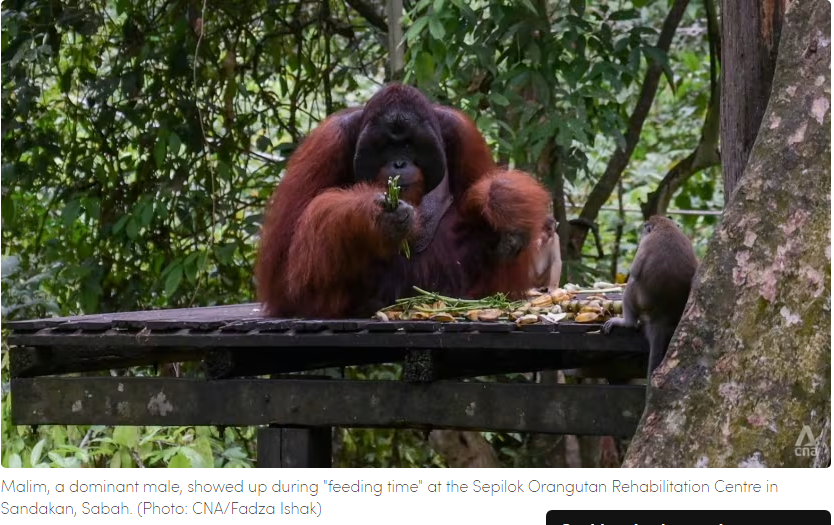
SANDAKAN: It is 3pm and feeding time at the Sepilok Orangutan Rehabilitation Centre in Sabah.
Malim, a majestic male orangutan with distinctive cheek pads, shuffles confidently onto the feeding platform, where bananas, sweet potatoes and vegetables like long beans have been laid out by the centre’s staff.
To the excitement of about 50 visitors watching from about 18m away, Malim starts tucking in, unperturbed by a group of macaques that are also helping themselves to the food.
A female orangutan and her baby soon join them.
Feeding takes place twice a day at Sepilok and is a highlight for many visitors to the centre, a popular tourist spot in Sabah.
Located at the fringe of the 4,294-hectare Kabili-Sepilok rainforest, the centre started in 1964 to rehabilitate orphaned, injured, and displaced orangutans and return them to the wild.
The forest is home to an estimated 150 to 200 orangutans while the centre, operated by the Sabah Wildlife Department, currently cares for 42 of the great apes.
There is no guarantee, however, that visitors will get to see orangutans at feeding time – and for the centre’s staff, that’s a positive sign.
The feeding platform is a gateway between the centre and the forest, and the staff provide a limited and monotonous spread for the orangutans to encourage them to forage independently in the wild.
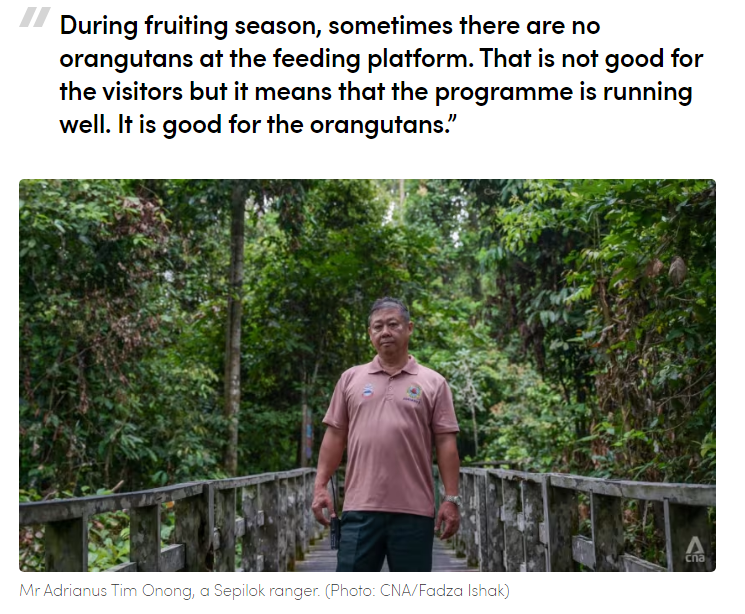
“The objective of this centre is for rehabilitated orangutans to be no longer dependent on us and to be free in the forest, where they can look for their own food,” said Mr Adrianus Tim Onong, a Sepilok officer.
The conservation and role of orangutans in Malaysia have come under the spotlight in recent months.
In May, plantation and commodities minister Johari Abdul Ghani said that the country should engage in “orangutan diplomacy” to counter bad press on palm oil and bolster relations with importers such as the European Union, India and China.
The European Union last year approved a ban on imports of commodities linked to deforestation, which could hurt the palm oil industry. Malaysia has criticised the law, calling it discriminatory.
Palm oil has been linked to the destruction of orangutan habitats, and Mr Johari said Malaysia – the world’s second-largest producer after Indonesia – cannot take a defensive approach.
Instead, it should show it is a sustainable palm oil producer committed to protecting forests and environmental sustainability, he said.
Inspired by China’s practice of sending pandas as diplomatic gifts to other countries, Mr Johari suggested giving orangutans to palm oil importers.
In 2023, the top importers of Malaysian palm oil were India (18.8 per cent), China (9.7 per cent), the European Union (7.1 per cent), Kenya (6.1 per cent) and Turkiye (5.8 per cent), according to the Malaysian Palm Oil Board.
The sector accounted for five per cent of the country’s gross domestic product in 2022.
But Mr Johari’s idea was quickly panned by conservationists as well as state officials in Sabah and Sarawak, the Malaysian states where wild orangutans are found.
https://www.channelnewsasia.com/asia/malaysia-orangutan-diplomacy-sabah-sepilok-palm-oil-conservation-endangered-apes-4453916
Sumber : Channel News Asia